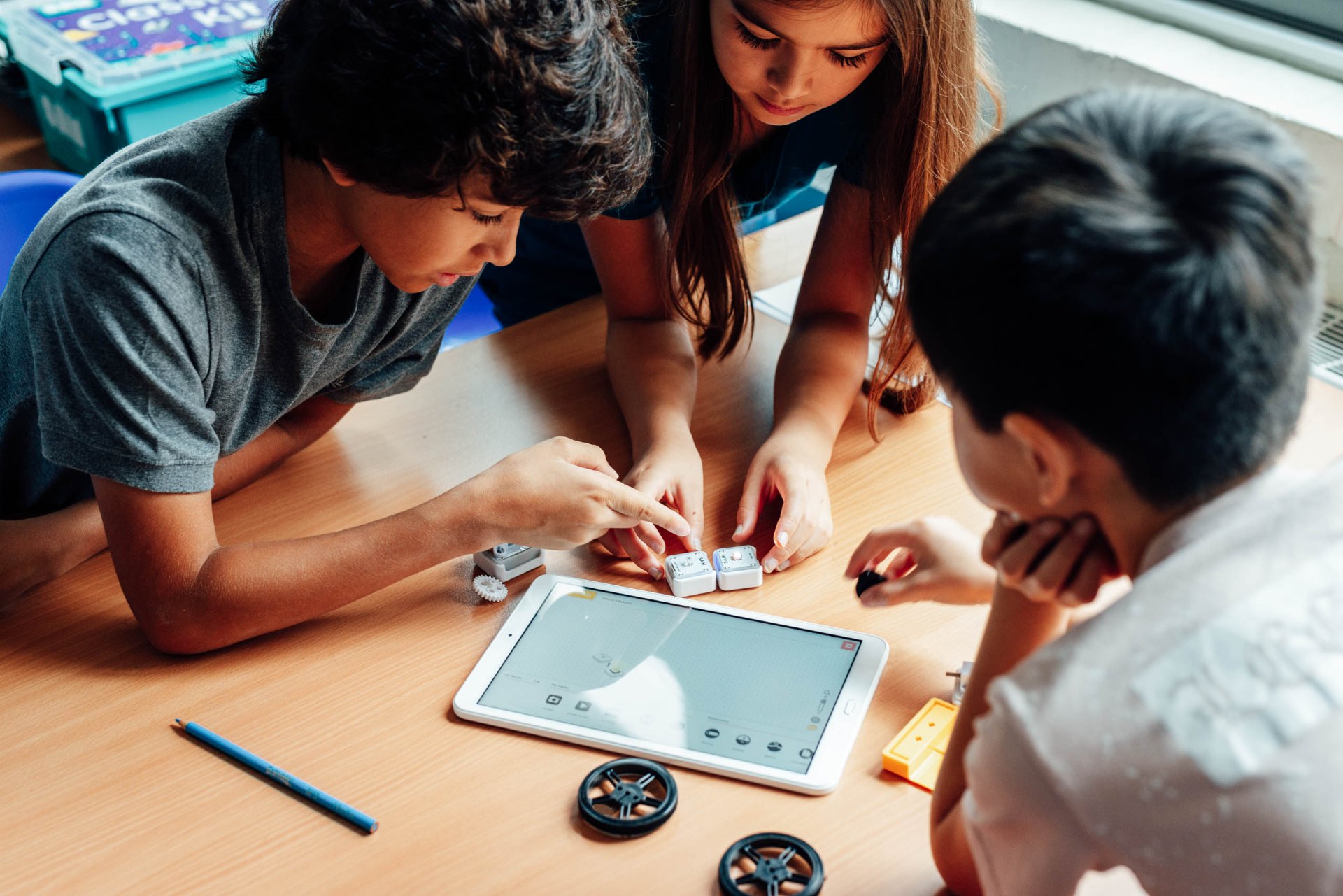
In today's rapidly evolving world, education must adapt to equip students with the skills and competencies needed to succeed in the workforce and make positive contributions to society. One framework that provides valuable guidance in this endeavor is the World Economic Forum (WEF) Education Framework.
With three core focuses, the WEF framework fosters problem-solving skills through real-world challenges. Let's explore the WEF education framework and how SAM Labs can support you in implementing core principles across your district.
Understanding the WEF Education Framework
The WEF Education Framework focuses on developing three primary aptitudes for today's learners, abilities and skills, attitudes and values, and knowledge and information.
With a main focus on the first two aptitudes, the goal is a holistic approach to education that builds concrete skills essential for economic success and develops a mindset and love of lifelong learning.
"In short, the future of education lies in empowering young learners to embrace and develop their uniquely human qualities – those unlikely to ever be replaced by technology," the WEF report states.
The problem is that abstract skills like problem-solving and communication can't easily be taught on their own. They require real-world challenges and situations to really understand and hone those skills.
For example, having students work together to design an app teaches in-demand skills like coding and programming, but it also helps develop key qualities like collaboration, communication, and creativity.
Why It's Important
While this framework and focus aren't new, there has been an increased focus on building these aptitudes in recent years. Today's employers are looking for critical-thinking and problem-solving people with interpersonal skills and increased global awareness.
These skills have been shown to have a dramatic impact on innovation, a company's bottom line, and the economy overall.
"Investing in just one important skill area, collaborative problem-solving, could add as much as $2.54 trillion to global GDP."
WEF Report
However, the push to develop these aptitudes is not just financially motivated. It's also about supporting the next generation as they look to build careers, families, and more. Research from UNICEF shows that many children and young people are behind. UNICEF's Recovering Learning report states that "Less than half of young people around the world are currently on track to acquire the full range of skills needed to thrive at work and in life."
"Investing in technologies like SAM Labs is investing in our children's ability to solve real-world problems collaboratively. It's about making education as dynamic and interconnected as the world around us. Embracing Education 4.0 is about preparing students not just for the jobs of tomorrow, but for the challenges they'll face in a constantly evolving global landscape."
Four Core Ideas
To help better understand and teach these abstract qualities, the Education 4.0 Taxonomy organizes a comprehensive set of aptitudes into a tree structure. The framework identifies four innovative ideas to help guide teaching and learning.
Personalized & self-paced learning
Personalizing the lessons and learning experience helps to build cognitive skills, social skills, and a growth mindset among students.
Accessible & inclusive learning
Building global citizenship and cultural competency, embracing multilingual and multicultural learning opportunities.
Problem-based & collaborative learning
Project-based learning that builds connections, interdependence, and personal accountability in group settings.
Lifelong & student-driven learning
Essential learning abilities that guide education from early childhood through secondary school, and beyond.
Supporting Core Areas with SAM Labs
SAM Labs is much more than a classroom technology solution for STEM programs. With curriculum that meets national and state standards and is continually evolving to help students thrive outside of the classroom, SAM Labs can help your district embody the WEF framework.
Personalized & Self-Paced Learning
SAM Labs allows students to work at their own pace with various lessons and experiments adjusted to their current grade or skill level. As students take on various lessons, minimal guidance from teachers is necessary, students are encouraged to tackle problems as they see fit.
For example, the Traffic Light project allows students to design and build a functioning traffic light system using SAM Labs hardware and software. Students can experiment with different configurations and observe the real-world implications of their designs.
Accessible & Inclusive Learning
SAM Labs works hard to support the needs of all learners, including English Language Learners, special education students, and others with unique backgrounds. The SAM Labs platform is available in 17 different languages, including unique content in Spanish.
SAM Labs often uses a visual programming language, reducing language barriers by relying on intuitive graphical elements rather than text-based commands.
increase in STEAM subject selections among female students

"SAM Labs exemplifies the transformative potential of Education 4.0 in action. Our collaboration with the Redmond School District in Oregon showcases this impact vividly."
Problem-based & Collaborative Learning
SAM Labs designs projects and activities that encourage collaboration among students. Whether through group challenges, cooperative problem-solving tasks, or shared projects, it's all about solving problems and experimenting together.
SAM Labs' Weather Board project involves students working in teams to design and build a weather monitoring system using SAM Labs sensors and actuators. Each team member contributes to different aspects, data collection, analysis, and visualization.
Lifelong & Student-driven Learning
SAM Labs projects are centered around topics and key skills that students will need throughout their education and beyond. Lessons discuss important issues like energy efficiency, transportation, digital citizenship, and weather. By engaging with real-world problems, students begin to think critically about global challenges and explore ways to create positive change in their communities.
Try SAM Labs Today
Address the core principles of the WEF Education Framework throughout K-12 classrooms in your district.
Request a demo